Speed Work in Running: Why Timing Matters More Than Intensity
Speed is a tempting idea for runners. It suggests lighter movement, faster splits, and visible progress. But it is also one of the easiest ways to disrupt a training cycle. The problem is not speed itself. It is how it is placed within training.
Speed is not a fixed type of workout. It is a quality that changes form as training evolves. When that progression is respected, speed supports the entire cycle. When it is not, it tends to produce fatigue without direction.
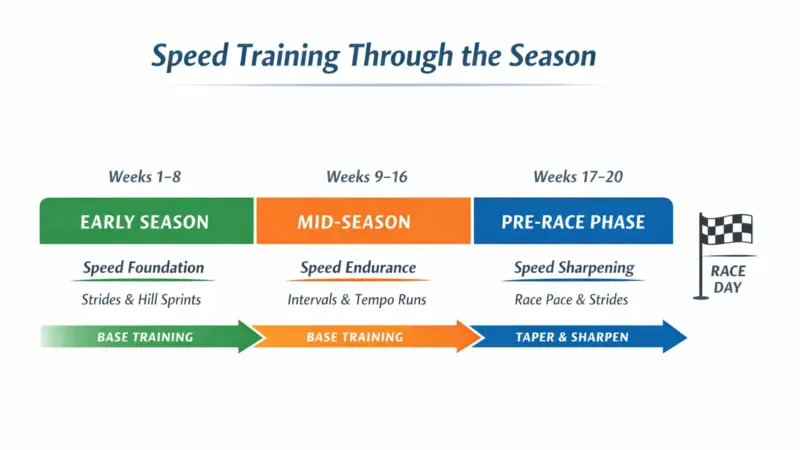
Early in the Cycle: Reintroducing Speed
At the beginning of a training cycle, the body is usually coming from a period of reduced structure or lower intensity. Aerobic work may still be present, but neuromuscular sharpness is often diminished.
This is why pure speed is most effective early, not as intensity, but as coordination.
Short sprints, light hill accelerations, and relaxed strides restore the connection between the nervous system and movement. These efforts are brief, typically under 10 seconds, and followed by full recovery to prevent fatigue from interfering with quality.
The effect is subtle but important. Ground contact becomes quicker. Stride timing improves. Movement feels more responsive. This does not increase endurance or raise fitness directly. It changes how efficiently existing fitness can be expressed. In this phase, speed raises the ceiling without adding significant load.
Mid-Cycle: Integrating Speed with Fatigue
As training progresses, aerobic volume increases and fatigue becomes a constant background condition. The question is no longer whether you can run fast, but whether you can sustain controlled effort while already under load. This is where speed shifts from coordination to integration.
Intervals, threshold runs, and longer repeats introduce a different kind of stress. Speed must now coexist with fatigue, rather than occur in isolation. The body is asked to maintain mechanics, rhythm, and control while metabolic demand is elevated.
This is where early speed work proves its value. Runners who have maintained neuromuscular sharpness tend to preserve form more effectively during these sessions. They are not just working harder, they are working more efficiently.
At the same time, the cost of speed increases. Recovery becomes more important. Small pacing errors accumulate more quickly. The margin between productive stress and excessive fatigue narrows.
Speed is no longer about how fast you can run. It becomes about how precisely you can control effort under fatigue.
Late Cycle: Protecting What You Built
As race day approaches, the role of speed changes again.
By this point, most of the meaningful adaptations have already occurred. Aerobic capacity, threshold, and movement efficiency have been developed over weeks of training. What remains is to preserve those adaptations and arrive at the start line with minimal residual fatigue.
This is where many runners misjudge speed. Continuing to push high-intensity sessions late in a cycle often creates more fatigue than adaptation. The body is no longer building, it is consolidating. Additional stress has diminishing returns.
Instead, speed becomes lighter and more selective. Short strides or relaxed fast repetitions maintain neuromuscular responsiveness without disrupting recovery.
The purpose shifts from development to expression. Speed is no longer something you build. It is something you keep accessible.
The Cost of Poor Timing
When speed is misplaced, its effects become clear. Introduced too early and too aggressively, it replaces foundational work rather than supporting it. Fatigue rises before the system is ready to absorb it.
Emphasized too heavily in the middle of a cycle, it competes with aerobic development. Sessions become harder, but not necessarily more effective. Pushed too late, it interferes with recovery. The result is often a runner who feels flat rather than sharp on race day.
In each case, the issue is not the type of workout. It is the interaction between that workout and the current state of the body. Speed amplifies whatever context it is placed in. If the context is wrong, the outcome is distorted.
Speed as a Changing Constraint
A useful way to think about speed is not as a tool, but as a constraint. Early in a cycle, the limiting factor is coordination. Speed removes that constraint. In the middle, the limiting factor is fatigue management. Speed exposes how well that is handled. Late in the cycle, the limiting factor is recovery. Speed must be reduced to protect it. Seen this way, speed does not follow a fixed plan. It responds to what the body can currently absorb.
A Simpler Perspective
Speed is not a phase. It is a quality that changes role. Early, it restores movement. Mid-cycle, it tests control under fatigue. Late, it maintains responsiveness without adding stress.
Runners who adjust speed to match these conditions tend to train more consistently and arrive at races with clearer legs and more stable pacing. The difference is rarely how fast they run in training. It is how well that speed fits into the larger structure of their preparation.
Closing Thought
Speed always feels productive. That is part of the problem. Because it feels effective, it is easy to overuse. Because it produces immediate feedback, it is easy to misinterpret. But speed does not operate in isolation. It interacts with fatigue, recovery, and the broader training context.
Used at the right time, it sharpens everything around it. Used at the wrong time, it quietly disrupts it. And that difference is rarely visible in a single session. It appears weeks later, in how the body responds, and how the race unfolds.