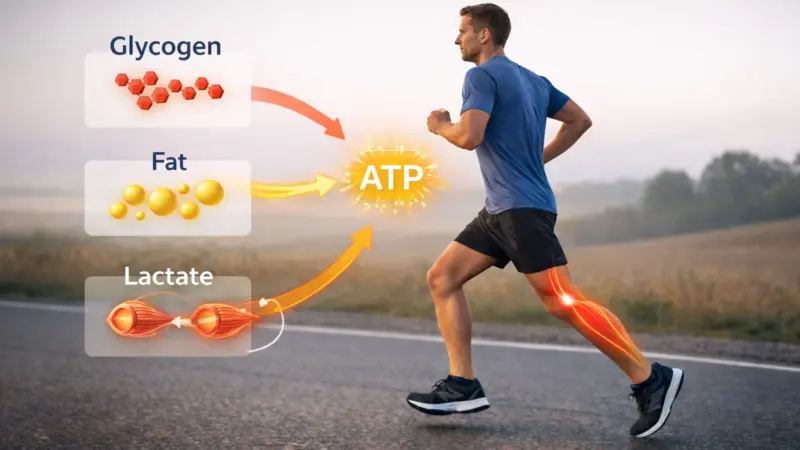
The Energy System of Running
Distance running often looks simple from the outside: a steady rhythm of steps, breath, and movement across the road. But beneath that rhythm, the body is constantly solving an energy problem.
Every stride requires muscles to produce energy again and again, sometimes for hours at a time. The ability to sustain that process, efficiently and continuously, is what ultimately defines endurance performance.
Understanding how this energy is produced helps explain why some paces feel sustainable, why others quickly become exhausting, and why training works the way it does.
Running Runs on ATP
At the most fundamental level, muscles do not run on carbohydrates or fat. They run on a molecule called ATP (adenosine triphosphate).
ATP is the immediate source of energy that powers muscle contraction. Every time a muscle fiber shortens, ATP is broken down and energy is released.
The body, however, stores only a very small amount of ATP. The supply available in muscles is enough to support just a few seconds of activity. For continuous movement—such as running—the body must constantly regenerate ATP from other fuels.
Those fuels come primarily from two sources: carbohydrates and fat.
Glycogen: The Fast Fuel
Carbohydrates are stored in the body mainly as glycogen, a form of glucose kept in muscles and the liver.
Glycogen is the body’s fastest available fuel. It can be broken down quickly to produce ATP, allowing muscles to sustain higher intensities. This makes it essential for faster running, including tempo efforts, race pace, and surges during competition.
The limitation is that glycogen stores are relatively small. Even well-trained runners can store only a few thousand calories of carbohydrate energy.
During prolonged running these stores gradually decline. When glycogen levels fall too low, maintaining pace becomes increasingly difficult. This is the physiological basis of the experience runners often describe as “hitting the wall.”
Fat: The Endurance Fuel
Fat provides the body with a second and much larger energy reserve.
Stored in adipose tissue and within muscle cells, fat can be broken down into fatty acids and used to produce ATP inside the mitochondria. Compared with glycogen metabolism, fat oxidation is slower and requires more oxygen.
Because of this, fat becomes the dominant fuel during lower-intensity running, when the demand for energy is steady but not extremely high.
The advantage is that fat stores are enormous. Even a lean endurance runner carries tens of thousands of calories in fat. This makes fat metabolism essential for long-distance running, especially during easy runs and long aerobic sessions.
In simple terms, easier running relies heavily on fat, while faster running gradually shifts the balance toward glycogen.
Lactate: The Misunderstood Energy Shuttle
When carbohydrate metabolism accelerates, another molecule appears in the system: lactate.
For many years lactate was blamed for fatigue and the burning sensation in muscles during intense exercise. Modern physiology has shown that this interpretation was incomplete.
Lactate is not simply a waste product. Instead, it acts as a transportable form of energy.
Muscle fibers that produce lactate can release it into the bloodstream or pass it to neighboring fibers. Other tissues, including slow-twitch muscle fibers and the heart, can then convert lactate back into usable energy.
This movement of energy between cells is known as the lactate shuttle. Rather than slowing runners down, lactate helps redistribute energy during demanding efforts.
Why Pace Changes Everything
The balance between glycogen and fat depends largely on running intensity.
At comfortable aerobic paces, the body can rely heavily on fat metabolism because energy demand is moderate. As pace increases, however, muscles require ATP more rapidly. Glycogen becomes increasingly important because it can deliver energy faster.
This shift between fuels happens gradually, but its consequences are significant. Even a small increase in pace can sharply increase glycogen consumption.
Over long distances, that difference matters. It helps explain why disciplined pacing is so important in endurance racing and why a pace that feels manageable early in a race can later become difficult to sustain.
Training Improves the System
Endurance training reshapes how the body produces energy.
With consistent aerobic running, muscles develop:
- more mitochondria, the structures responsible for generating ATP
- improved ability to oxidize fat
- greater glycogen storage capacity
- more efficient use and transport of lactate
These adaptations allow trained runners to sustain higher speeds while still relying significantly on fat metabolism. In practical terms, the body becomes better at producing energy economically over long periods of time.
The Quiet Foundation of Endurance
Endurance running is often described as a test of discipline or mental strength. Yet beneath those qualities lies something quieter and equally important: the body’s ability to manage energy.
Every run depends on a delicate balance between glycogen, fat metabolism, and the continuous regeneration of ATP. Pace shifts that balance. Training refines it. Experience teaches runners how to work within it.
Runners rarely think about these processes while moving down the road. But the energy system is always there, quietly shaping every stride, every pacing decision, and every race outcome.