
Lactate in Running: Why It’s Not What Slows You Down
Late in a hard effort, when your legs begin to burn and your pace starts to slip, it’s easy to believe your body is failing. For decades, runners were told to blame lactate. Among runners, few concepts are as widely misunderstood as lactate.
For years it was blamed for fatigue, burning legs, and the slowing that comes late in hard efforts. Many athletes were taught that intense running causes the body to “fill with lactic acid,” eventually forcing the pace to drop.
Modern exercise physiology tells a very different story. Lactate is not the enemy of endurance. In fact, it is an important part of how the body produces and moves energy during running.
What Lactate Actually Is
When muscles produce energy from carbohydrate, glucose is broken down through a series of reactions known as glycolysis. One of the intermediate products of this process is a molecule called pyruvate. When the demand for energy rises, some of this pyruvate is converted into lactate.
This conversion happens constantly, even at relatively moderate intensities. Lactate production is not limited to sprinting or extreme effort. It is a normal part of metabolism whenever carbohydrates are used for energy.
This process is not rare or exceptional. It is happening even during a steady run, long before discomfort appears—quietly, continuously, in every working muscle.
Rather than being a waste product, lactate serves an important role in keeping energy production running smoothly.
The Body Reuses Lactate
One of the most important discoveries in modern physiology is that lactate is not simply discarded by the body.
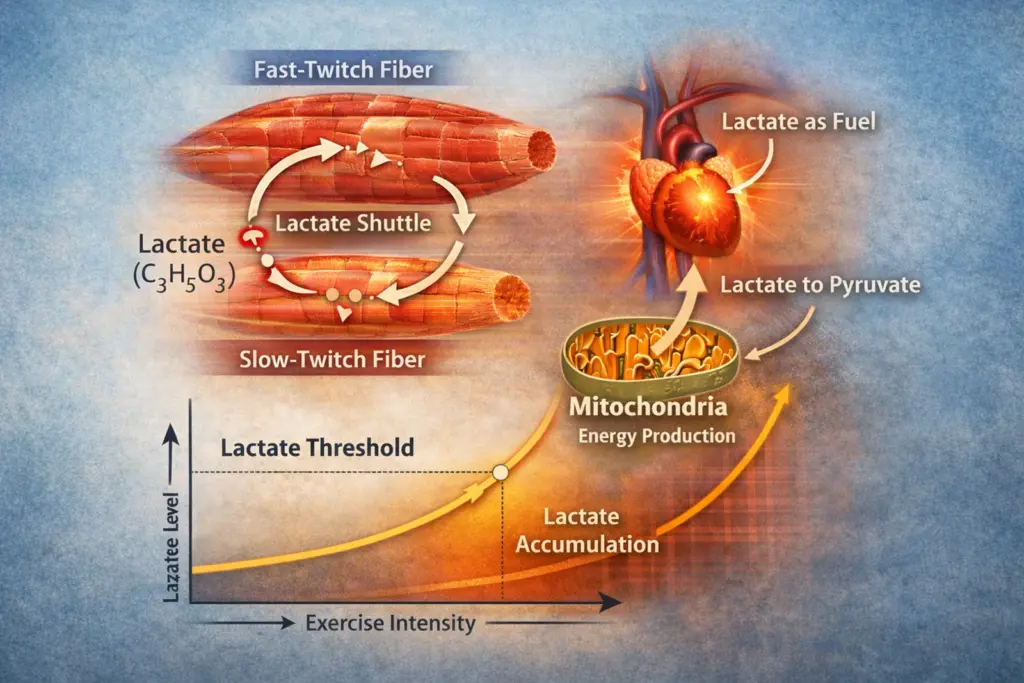
Instead, it is recycled and used as fuel. Muscle cells can take up lactate and convert it back into pyruvate, which then enters the mitochondria to produce energy aerobically. In other words, lactate can be burned for fuel.
This process occurs continuously during exercise. Lactate moves through the bloodstream and between muscle fibers, supplying energy where it is needed. This concept is often described as the lactate shuttle.
Fast Fibers and Slow Fibers
Different muscle fibers play different roles in this process. Fast-twitch fibers, which are more active during higher-intensity running, tend to produce lactate more rapidly. Slow-twitch fibers, which are highly aerobic, are particularly good at using lactate as fuel.
As a result, lactate can move from one muscle fiber to another, where it is oxidized to produce energy. The heart also uses lactate efficiently. During hard exercise, the heart may rely on lactate as one of its preferred fuels.
Why Lactate Levels Rise
If lactate can be used as fuel, why does it sometimes accumulate during intense running?
The answer lies in production versus removal. At moderate intensities, the body can clear lactate as quickly as it is produced. Muscles, the heart, and the liver all help recycle it.
But as running intensity increases, lactate production accelerates. Eventually, the rate of production becomes greater than the body’s ability to remove or reuse it.
This turning point—where production begins to outpace clearance—is known as the lactate threshold. It marks the boundary between effort that feels controlled and effort that slowly unravels.
What Actually Causes the Burning Sensation
The burning sensation is not caused by lactate. It is linked to the accumulation of hydrogen ions as energy demand rises, disrupting muscle contraction.
Lactate, if anything, helps buffer this process rather than cause it. In other words, lactate is not the problem—it is part of the body’s attempt to manage high energy demand.
Lactate and Endurance Training
Endurance training significantly changes how the body handles lactate.
With consistent training, runners typically develop:
- More mitochondria within muscle cells
- Greater capacity to use lactate as fuel
- Improved transport between tissues
- A higher sustainable threshold
These adaptations allow trained runners to sustain faster speeds before lactate accumulation becomes significant. In practical terms, the body becomes better at using lactate rather than allowing it to build up.
This is why small increases in pace can feel manageable at first, and then suddenly costly—the underlying balance has shifted.
Lactate as a Marker, Not a Villain
In modern endurance science, lactate is often used as a marker of metabolic intensity rather than a cause of fatigue. When lactate levels rise rapidly, it indicates that carbohydrate metabolism is working at a high rate and that the body is approaching a limit in sustainable energy production.
For runners, this threshold is one of the key determinants of performance in events ranging from the 5K to the marathon.
A Different Way to Think About Lactate
Instead of viewing lactate as something that slows runners down, it is more accurate to see it as part of the body’s energy system. It is produced when carbohydrate metabolism accelerates. It is transported through the body. And it is reused as fuel by muscles, the heart, and other tissues.
Far from being a waste product, lactate is part of the elegant system that allows the body to manage energy during demanding exercise. The challenge for runners is not to avoid lactate. It is to become the kind of athlete who can produce it, move it, and use it efficiently.
That ability doesn’t announce itself loudly. But it is one of the quiet signatures of endurance.