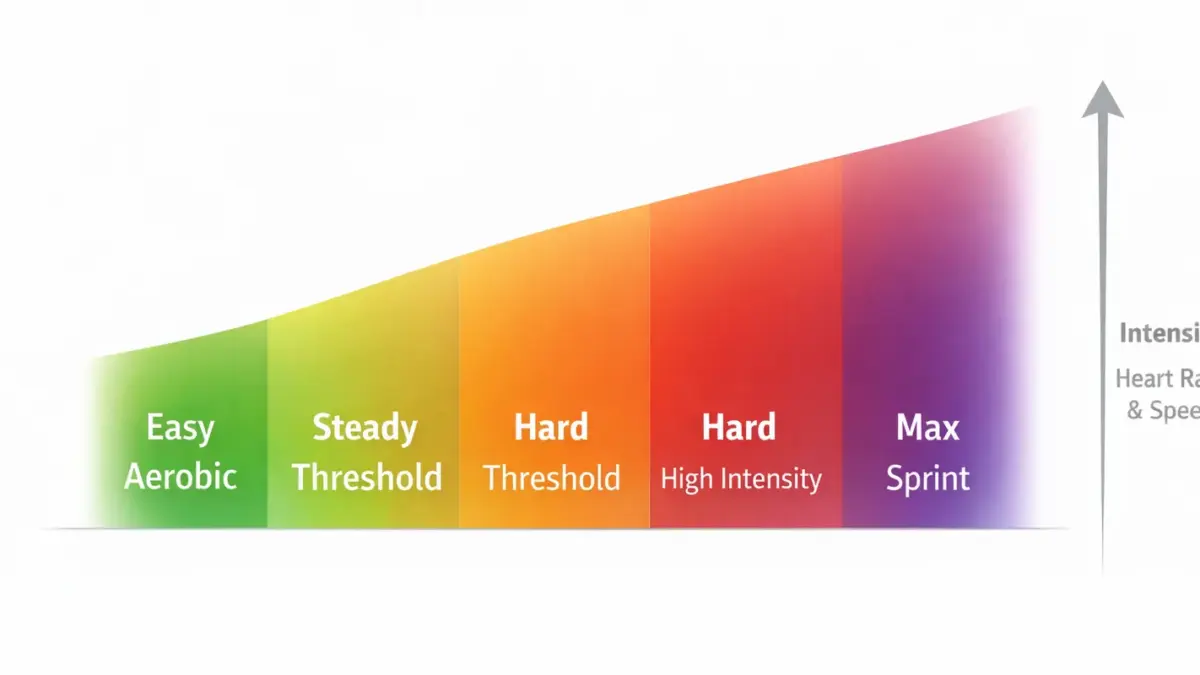
Training Zones Are a Tool, Not a Plan
Training zones promise clarity. Numbers, colors, neat labels on a watch screen — all suggesting that if effort stays inside the right box, progress will follow. For many runners, that structure feels reassuring. It turns training into something measurable and seemingly controlled.
But zones don’t train you.
How you use them does.
For amateur runners especially, training zones are often treated as rules rather than references. The result is not chaos, but something quieter and more stubborn: stalled progress, lingering fatigue, and the sense of doing “everything right” without getting much faster.
This article isn’t about rejecting zones. It’s about putting them back in their proper place.
What Training Zones Really Represent
At their core, training zones are models. They attempt to group continuous physiological processes into manageable categories. Aerobic work, threshold stress, high-intensity oxygen demand, neuromuscular speed — these are real adaptations. Zones are simply a way to talk about them.
The problem starts when the model is mistaken for the body itself.
Your physiology doesn’t flip a switch when you cross a heart-rate boundary. Lactate doesn’t suddenly appear because your watch vibrates. Oxygen uptake, muscle fiber recruitment, and fatigue accumulate gradually, influenced by sleep, stress, temperature, nutrition, and training history.
Zones describe tendencies, not guarantees.
That doesn’t make them useless. It makes them approximate — and approximation requires judgment.
Why Zones Feel So Convincing
Zones are appealing because they offer three things runners crave:
- Simplicity – Training becomes easier to plan and easier to explain.
- Objectivity – Numbers feel more trustworthy than perception.
- Control – Effort appears predictable and repeatable.
For runners balancing work, family, and limited training time, this structure is genuinely helpful. Zones can prevent reckless pacing and keep hard days from turning into daily habits.
But simplicity has a cost. The more tightly runners cling to zone definitions, the less responsive they become to what their body is actually doing.
The Comfortable Middle: Where Progress Quietly Slows
One of the most common patterns in amateur training is not too little intensity or too much. It’s too much sameness.
Runs are rarely easy enough to be truly restorative. They’re also rarely hard enough to provoke meaningful adaptation. Many sessions settle into a steady, controlled discomfort — often justified as “Zone 2–3,” “moderate aerobic,” or “comfortably hard.”
This middle intensity feels productive. Breathing is elevated. Pace looks respectable. Effort feels honest.
Physiologically, though, it’s a gray area. It doesn’t maximize aerobic development, and it doesn’t sharpen speed or threshold efficiently. Over time, it accumulates fatigue without clearly signaling the body to adapt.
Zones didn’t cause this problem.
Unclear separation of effort did.
Zones Don’t Replace Intent
A useful training question is not “Which zone am I in?”
It’s “What am I trying to improve today?”
- Is this run meant to build durability and circulation?
- Is it designed to stress lactate handling?
- Is it about neuromuscular sharpness and economy?
- Or is it simply there to support recovery?
When intent is clear, zones help. When intent is vague, zones become decoration.
Two runners can complete identical workouts at the same heart rate and experience completely different outcomes depending on background fitness, accumulated fatigue, and recovery capacity. The watch records the effort; the body interprets it.
The Problem With Treating Zones as Fixed
Most zone systems assume stability. In reality, zones drift constantly.
They shift:
- Across a training season
- With improving fitness
- Under heat or dehydration
- During periods of stress or poor sleep
Early in a season, threshold effort may feel awkward and unstable. Later, that same effort becomes controlled and economical. The “zone” didn’t change — the runner did.
Rigid zone obedience can hide these changes instead of revealing them.
Zones Across the Training Season
Where zones do become genuinely useful is when they’re understood in context.
Early season
Intensity boundaries are loose. Aerobic development dominates, and short bouts of faster running improve coordination and efficiency without heavy fatigue. Zones here are broad, descriptive, forgiving.
Mid-season
Separation becomes clearer. Easy runs stay easy. Threshold work becomes more defined. High-intensity sessions are deliberate and limited. Zones now help regulate stress.
Late season
Specificity narrows focus. Fewer intensities matter. Precision increases, but volume of hard work often decreases. Zones guide restraint more than ambition.
The same zone number does not mean the same thing in every phase.
Watches Measure Output, Not Cost
Another quiet limitation of zone-based thinking is that it measures what you produce, not what it costs you.
Heart rate, pace, and power tell you how hard you’re working externally. They don’t fully capture:
- How much recovery this effort will require
- How it interacts with yesterday’s session
- Whether today’s stress fits into the week as a whole
A runner can “stay in zone” and still overreach if the surrounding context is wrong. Fatigue doesn’t announce itself with a warning tone. It accumulates quietly.
A More Useful Way to Use Zones
Training zones work best when they are treated as language, not law.
They help you:
- Describe effort patterns
- Review training balance
- Communicate with coaches or training partners
- Avoid obvious pacing mistakes
They work poorly when they are used to:
- Justify every run
- Replace perception
- Eliminate flexibility
- Ignore seasonal context
Experienced runners often appear less dependent on zones not because they’re reckless, but because they’ve internalized what different efforts feel like. Zones then become confirmation, not instruction.
Precision Comes From Contrast, Not Categories
Effective training isn’t built on perfectly labeled sessions. It’s built on contrast.
Easy days that are unmistakably easy.
Hard days that are clearly demanding.
Enough space between them for adaptation to occur.
Zones can help enforce that contrast — but only if the runner is willing to let go of the illusion that the model itself guarantees progress.
The Quiet Skill Zones Can’t Teach
The most important training skill is not choosing the correct zone. It’s learning to interpret feedback.
How does fatigue carry into the next day?
Does effort feel economical or forced?
Is recovery improving or stagnating?
No zone chart answers those questions. Experience does.
Training zones are valuable tools. They offer structure, language, and restraint. But they are not a plan, and they are not a substitute for understanding how stress, recovery, and adaptation interact over time.
Used wisely, they clarify training.
Used rigidly, they flatten it.
And for runners trying to improve year after year, that distinction matters more than any number on a screen.