
The Science of the Warm-Up: Neuromuscular and Tendon Behavior Before Easy Runs
The question isn’t whether warm-ups increase heart rate.
It’s whether they meaningfully change how your neuromuscular system and tendons handle load.
For high-intensity work, the answer is clearly yes.
For easy runs, the answer is more nuanced — and more interesting.
Oxygen Kinetics Is Only the Surface
Most discussions stop at cardiovascular readiness: faster oxygen uptake, smoother transition from anaerobic contribution, quicker steady state.
That matters. But during easy running, oxygen demand is modest. Your body will reach steady state within a few minutes regardless.
The deeper question is mechanical:
How prepared are your tendons and motor units to absorb and recycle force?
Tendons Are Not Passive Ropes
Running is elastic.
With each stride, tendons — particularly the Achilles and patellar tendons — store mechanical energy during landing and release it during push-off. This spring-like behavior reduces metabolic cost.
However, tendon stiffness is temperature dependent.
Cold tendons are:
- Slightly less compliant
- Slower to transmit force
- Less efficient at elastic recoil
A short warm-up increases local tissue temperature, which alters collagen viscoelastic properties. In practical terms, tendons become more responsive under cyclic load.
During an easy run, the forces are lower than sprinting — but they are still 2–3 times bodyweight with every step.
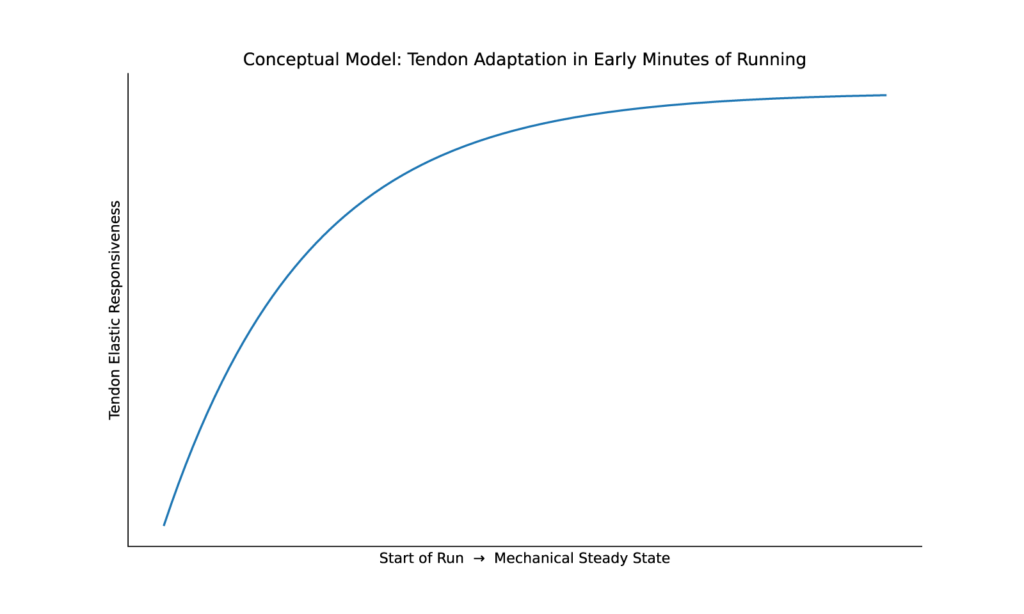
If you start conservatively, tendons progressively adapt to loading within the first several minutes.
If you start abruptly, the strain rate increases before tissue stiffness has adjusted.
The risk is not dramatic injury.
It’s inefficient mechanics and localized overload.
Motor Unit Recruitment: The Quiet Adjustment
At rest, your nervous system is not primed for rhythmic elastic activity.
Warm-ups influence:
- Motor unit synchronization
- Firing frequency
- Intermuscular coordination
In simple terms, your stride becomes smoother and more economical.
During easy running, this process happens naturally — but only if intensity remains low. A sudden jump in pace requires rapid recruitment of higher-threshold motor units before coordination stabilizes.
That mismatch is often felt as:
- Heavy legs
- Sloppy stride
- Early calf tightness
Not because the run is hard — but because the transition was abrupt.
Elastic Efficiency and Running Economy
There is evidence that a proper warm-up can improve running economy in submaximal efforts by optimizing muscle-tendon interaction.
The mechanism is subtle:
- Slight increase in muscle temperature
- Improved cross-bridge cycling speed
- Better elastic energy return
- Reduced ground contact inefficiency
In races or tempo efforts, this translates into measurable performance gains.
In easy runs, the benefit is mostly perceptual and mechanical — smoother loading patterns and more consistent stride rhythm.
So Do You Need a Warm-Up for Easy Runs?
Mechanically speaking:
If the run begins at a low intensity and increases gradually, the first 5–10 minutes act as progressive tendon loading and neuromuscular calibration.
If the run begins near moderate pace, a warm-up becomes protective rather than optional.
Cold morning + immediate pace = higher strain rate before tissue adaptation.
Gradual start = mechanical adaptation occurs in real time.
A More Precise Framework
Dedicated warm-up recommended when:
- Temperature is low
- You’re older or returning from injury
- The run includes hills or surges
- You tend to start faster than you realize
Warm-up optional when:
- Temperature is mild
- You begin deliberately below your normal easy pace
- You allow cadence and stride length to evolve naturally
The Real Principle
Warm-ups are not about ritual.
They are about managing strain rate.
Tendons adapt to load.
The nervous system adapts to rhythm.
Both dislike abrupt transitions.
An easy run that starts slowly is mechanically intelligent.
An easy run that starts hurriedly creates unnecessary elastic stress before the system is tuned.
The distinction is small in the moment.
Over months of training, it becomes meaningful.