
The Second Hour Problem
Why so many easy runs go wrong after 60 minutes — and what to do about it.
You leave the door feeling good. The first half hour flows. At 45 minutes everything still feels controlled. Then, somewhere past the hour mark, something quietly shifts — the pace creeps up, the breathing shortens, the watch starts showing numbers that belong to a different kind of run. You didn’t decide to push. You didn’t feel yourself cross a line. But you did.
This is the second hour problem. And it’s one of the most common — and least-noticed — ways that recreational runners undermine their own training.
What actually changes at 60 minutes
It isn’t that you’ve become tired in the obvious sense. The shift is subtler than that. Three things converge around the one-hour mark: core temperature rises to the point where cardiovascular strain begins to amplify, glycogen availability starts to decline — especially if you ran fasted — and crucially, the brain’s ability to accurately perceive effort starts to blur.
Each of these alone is manageable. Together, they create a situation where the body quietly recruits more resources to maintain the same pace, without ever signaling clearly that this is happening.
“The pace didn’t change. The cost did.”
The mechanism behind cardiac drift
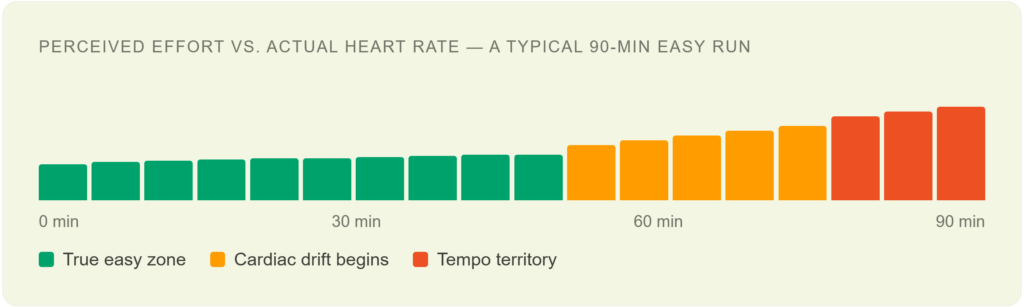
Cardiac drift is the gradual rise in heart rate — without any increase in running pace — that occurs during prolonged aerobic exercise. As you sweat and lose fluid, plasma volume decreases. The heart compensates by pumping faster to maintain cardiac output. The result: the same 5:30/km that cost you 138bpm at minute 20 might cost you 152bpm by minute 75.
Key concept: Cardiac drift isn’t a sign of fitness or effort — it’s a cardiovascular compensation mechanism. A heart rate rising past your easy ceiling isn’t “strong running.” It’s a sign your easy run has quietly become something else.
Most runners interpret the drift as normal fatigue and push through. The problem isn’t the discomfort — it’s the adaptation cost. A run that spends its final 30 minutes in zone 3 or 4 no longer functions as an easy aerobic stimulus. It accumulates fatigue without delivering the training signal you intended.
Why you don’t notice it happening
Accumulated fatigue has a way of recalibrating your perception of effort. Neurologically, the brain down-regulates its sensitivity to internal signals the longer a run goes on — a protective mechanism that helps you keep moving, but also makes it harder to accurately judge how hard you’re actually working.
This is why runners often describe the second half of a long run as “feeling smooth” even as their heart rate is climbing steadily. They’re not lying. Their perception has simply adjusted to a new normal, one that has drifted well past easy.
Why it matters for your next session
The hidden cost of a drifted easy run isn’t felt during the run itself — it’s felt 16 hours later, when your interval session feels flat, or 48 hours later when what should be an easy recovery jog feels harder than it should. The aerobic base you thought you were building was partially mortgaged to absorb a run that was harder than planned.
Over weeks, this pattern quietly erodes the quality of every hard session. Not through any single bad run, but through the cumulative effect of easy days that weren’t easy enough.
Four ways to keep easy runs honest past the hour mark
01 — Use a heart rate ceiling, not a pace target.
If your easy ceiling is 145bpm, slow down to stay under it — regardless of what the pace says.
02 — Take a small carbohydrate source for runs over 75 minutes.
Even 20–30g/hr reduces glycogen stress and blunts the late-run drift.
03 — Build in a check-in at 50 minutes.
Ask: is my breathing still fully nasal? Can I hold a sentence without pausing? If not, slow down deliberately.
04 — Accept that the second half of a long easy run will feel slower than it looks on paper.
A slower final 30 minutes is usually more valuable than a faster one.
The goal isn’t to run slowly for its own sake. It’s to ensure that when you plan an easy run, you actually get one — and that the session you log matches the session your body experienced.
Easy days build the base. Hard days test it. But only if the easy days are genuinely easy.
The second hour is where many training plans quietly fall apart — not through bad decisions, but through the absence of attention to what the body is already telling you.